Affichage des articles dont le libellé est National Team Lineups. Afficher tous les articles

lundi 12 juillet 2021

UEFA Euro 2020 Lineups (played in 2021)

 WINNERS : ITALY

ITALY 2021

As in the Final. In : Cristante, Beradi (54'), Bernardeschi (86'),  Belotti (91'), Locatelli (96'), Florenzi (116'). Injuried (during the Q/F's) : Spinazzola (the overactive LB of this tournament, until that point when he broke his Achille tendon).

Runners-up : England.

England 2021

As in the Final. In : Saka (70'), Henderson (74', out at the 120'), Grealish (94'), Rashford and Sancho (120'). Prior to the final, in case of a four-men defense, in a 4-2-3-1, Saka started on the right (Trippier did not play). Most used substitute (but also often subbed out after he was subbed in) : Grealish. Foden did not impose himself and was not used in the final. Rashford and most of all Sancho had no playing-time before the penalty shootout won by Italy where both failed to score before that Saka missed, him too.


Semi-finalist A : Spain.

Spain 2021

As it was over the k-o stages. Moreno was even used on the right wing in the groups. Sarabia too (his usual position). Oyarzabal was the starting CF in the semi-finals although he's usually used as a winger. Morata replaced him and scored in these semi-finals.

Semi-finalist B : Denmark.

Denmark 2021

The young Damsgaard numerically replaced the playmaker and national star-player Eriksen who collapsed in the very first game of the group stage against Finland, in Copenhagen. Damsgaard played upfront and did great. At last, Yussuf Poulsen (forward) scored 2 goals, during the group stage phase : as a winger (Belgium, 1-2 loss) then as a centre-forward (Russia, 4-1 win) but he did not have any remarkable contribution during the k-o stages.

lundi 18 novembre 2019

Wales National Football Team's best XI's and Top Scorers by Year


The Welsh national football team only qualified for two final tournaments in its History (1 World Cup and 1 Euro) but did fairly well each time by reaching the quarter-finals of the 1958 World Cup in Sweden (elilminated by the eventual champion Brazil) and even the last-four of the Euro 2016, in France (eliminated by the eventual winner Portugal).

Here are these two legendary teams that more than half a century separates.

Wales, 1958 World Cup quarter-finalists : 

Wales 1958
Wales at the 1958 World Cup
1st Round :
Hungary - Wales : 1-1 (J. Charles)
Mexico - Wales : 1-1 (I. Allchurch)
Sweden - Wales : 0-0
Wales - Hungary : 2-1 (I. Allchurch, Medwin)
Quarter-finals :
Brazil - Wales : 1-0
The OR-IR pairing was Webster-Medwin in the two first group matches against Hungary and Mexico then Vernon-Hewitt in the third match against Sweden, Medwin-Hewitt in a fourth and decisive group match against Hungary and Medwin-Hewitt again in the quarter-finals.
John Charles missed the quarter-finals and the match against Brazil (0-1 with a goal by the 17 years old phenomenon Pelé). Webster was his substitute to fill the centre forward role for this match.


Wales, Euro 2016 Semi-finalists (winner of Belgium in the quarter-finals then eliminated by Portugal in the semi-finals).

Wales 2016
Wales at Euro 2016
1st Round/ Group Stage (1st of the group) :
Wales - Slovakia : 2-1 (Bale, Robson-Kanu)
England - Wales : 2-1 (Bale)
Russia - Wales : 0-3 (Ramsey, Taylor, Bale)
Round of 16 :
Wales - Northern Ireland : 1-0 (o.g.)
Quarter-finals :
Wales - Belgium : 3-1 (Williams, Robson-Kanu, Volkes)
Semi-finals :
Portugal - Wales : 2-0


Collins took the centre of the defense when he had to replace Davies when the latter got suspended (and Williams, usually in the middle, took the left hand of the defense). Arsenal's Ramsey was suspended for the semi-finals and was replaced by King in this occasion.

We'll finally take note that Wales was "quarter-finalist" of the Euro 1976 when the finals still consisted only in the semi-finals, the little final and the final. They had qualified to this stage of the competition by topping their group ahead of Hungary, Austria and Luxembourg and then were eliminated by Yugoslavia (0-2 loss away in Zagreb then 1-1 at Ninian Park in a bad-tempered match).
The team included the likes of Mike England (the centre-half), Leighton James (winger), Terry Yorath (the midfielder of Leeds) or John Toshack (the centre forward of Liverpool).

The 50's are widely considered as the golden age of the Welsh national team and an outstanding player of the time but who was born too early to be part of the 1958 team was the wing-half Ron Burgness, of Tottenham.

From 1976 to 2016, the Welsh only knew some punctual successes of prestige. You can consult this section of the national team's wiki page in order to spot them as a start. And also to figure out who are the other noticeable players in the team's History (consulting the whole article).
You'll also certainly find some interesting websites in order to know more.

As announced, the point here is just to hughlight the most successful teams and to offer the list of the national team's top scorer by year and here it is now, as for the second part of this article, here.

Wales National Team's top scorers by year.


1876 : no goals scored (1 match).
1877 : no goals scored (1 match).
1878 : no goals scored (1 match).
1879 : William Davies (Oswestry Utd), 1 goal.
1880 : William Roberts (Llangollen), 2 goals.
1881 : William Bell (Shrewsbury Engineers), John Morgan (Derby School Staff), Knyvett Crosse & John Vaughn (Ruabon Druids), 1 goal.
1882 : William Owen (Ruthin) & John Price (Wrexham), 4 goals.
1883 : Walter Roberts (Ruthin), 1 goal.
1884 : Walter Roberts (Ruthin) & Edward Shaw (Oswestry Utd), 2 goals.
1885 : Herbert Sisson (Wrexham), 3 goals. John Roach (Oswestry), 2.
1886 : 7 players with 1 goal scored.
1887 : Jack Powell (Newton Heath) & Henry Sabine (Oswestry), 1 goal.
1888 : Jack Doughty (Newton Heath), 6 goals.
1889 : Richard Jarrett (Ruthin), 3 goals.
1890 : William Pryce-Jones (Nwtown), 2 goals.
1891 : John Bowdler (Shrewsbury), 2 goals.
1892 : Benjamin Lewis (Chester then Crewe Alexandra), 2 goals.
1893 : George Owen (Chirk), 2 goals.
1894 : Billy Lewis (Chester) & Hugh Morris (Sheffield Utd), 2 goals.
1895 : Billy Lewis (Chester) & Harry Trainer (Wrexham), 2 goals.
1896 : Billy Lewis (Chester) & Billy Meredith (Manchester City), 2 goals.
1897 : Billy Meredith (Manchester City), 2 goals.
1898 : Morgan Morgan-Owen (Corinthians) & John Thomas (Bangor FC), 2 goals.
1899 : no goals scored (3 matches).
1900 : Billy Meredith (Manchester City) & Thomas Parry (Oswestry), 2 goals.
1901 : Thomas Parry (Oswestry) & John Jones (Bangor), 1 goal.
1902 : Hugh Morgan-Owen (Oxford), 1 goal.
1903 : Walter Watkins (Stoke), 1 goal.
1904 : Walter Watkins (Aston Villa), Bobby Atherton (Middlesbrough) & Lloyd Davies (Stoke), 1 goal.
1905 : Walter Watkins (Sunderland) & Grenville Morris (Nottingham Forest), 1 goal.
1906 : Arthur Green (Notts County), 3 goals.
1907 : William Jones (Manchester City), 2 goals.
1908 : William Jones (Manchester City) & Tinker Davies (Blackburn), 1 goal.
1909 : William Jones (Manchester City) & Tinker Davies (Blackburn), 2 goals.
1910 : Grenville Morris (Nottingham Forest) & Bobby Evans (Sheffield Utd), 2 goals.
1911 : Grenville Morris (Nottingham Forest), 3 goals.
1912 : Tinker Davies (Blackburn) & David Davies (Treharris), 1 goal.
1913 : Billy Meredith (Manchester Utd), Ernest Peake (Liverpool), James Roberts (Wrexham) & Walter Davis (Milwall), 1 goal.
1914 : Evan Jones (Bolton), 1 goal.
1920 : Stanley Davies (Preston), 3 goals.
1921 : Stanley Davies (Everton), Billy Hole (Swansea) & Dai Collier (Grimsby), 1 goal.
1922 : Len Davies (Cardiff), 2 goals.
1923 : Fred Keenor (Cardiff) & Ivor Jones (West Brom), 1 goal.
1924 : Willie Davies (Swansea), 2 goals.
1925 : Fred Keenor (Cardiff) & Billy Williams (Northampton), 1 goal.
1926 : Jack Fowler (Swansea), 2 goals.
1927 : Len Davies (Cardiff) & David Williams (The Wednesday), 2 goals.
1928 : Willie Davies (Cardiff then Notts County), 3 goals.
1929 : Len Davies (Cardiff), Taffy O'Callaghan (Tottenham), Fred Warren (Cardiff) & Billy Mays (Wrexham), 1 goal.
1930 : Thomas Bamford (Wrexham), 1 goal.
1931 : Ernest Curtis (Birmingham), 2 goals.
1932 : Dai Astley (Aston Villa), 3 goals. O'Callaghan (Tott.) & Walter Robbins (West Brom), 2.
1933 : Dai Astley (Aston Villa), 2 goals.
1934 : Dai Astley (Aston Villa) & Charlie Philipps (Wolverhampton), 1 goal.
1935 : Charlie Philipps (Wolverhampton), 2 goals.
1936 : Pat Glover (Grimsby), 3 goals. Astley, 2.
1937 : Pat Glover (Grimsby) & Bryn Jones (Wolverhampton), 2 goals.
1938 : Dai Astley (Derby), 3 goals.
1939 : Dai Astley (Blackpool), Pat Glover (Grimsby), Horace Cumner (Arsenal) & Les Boulter (Brentford), 1 goal.
1946 : Trevor Ford (Swansea) & Bryn Jones (Arsenal), 1 goal.
1947 : Trevor Ford (Aston Villa), 2 goals.
1948 : Bryn Jones (Arsenal), George Edwards (Birmingham) & George Lowrie (Coventry), 1 goal.
1949 : Trevor Ford (Aston Villa), 7 goals.
1950 : Trevor Ford (Aston Villa), 2 goals.
1951 : Trevor Ford (Sunderland), 4 goals. I. Allchurch (Swansea), 3.
1952 : Trevor Ford (Sunderland), 3 goals.
1953 : John Charles (Leeds), 4 goals. Ford & Allchurch, 3.
1954 : John Charles (Leeds), 3 goals.
1955 : John Charles (Leeds), 4 goals.
1956 : John Charles (Leeds), Trevor Ford (Cardiff), Terry Medwin (Tottenham) & Roy Clarke (Man City), 1 goal.
1957 : Des Palmer (Swansea), 3 goals.
1958 : Ivor Allchurch (Swansea then Newcastle), 5 goals.
1959 : John Charles (Juventus), Graham Moore & Derek Tapscott (Cardiff), 1 goal.
1960 : Cliff Jones (Tottenham), 4 goals.
1961 : Ivor Allchurch (Newcastle) & Cliff Jones (Tottenham), 3 goals.
1962 : Melvyn Charles (Cardiff), 4 goals.
1963 : Cliff Jones (Tottenham), 4 goals.
1964 : Ken Leek (Birmingham), 2 goals.
1965 : Roy Vernon (Stoke), 6 goals. I. Allchurch (Cardiff then Swansea), 5.
1966 : Wyn Davies (Bolton then Newcastle) & Ron Davies (Norwich then Southampton), 2 goals.
1967 : Ron Davies (Southampton) & Alan Durban (Derby), 1 goal.
1968 : Wyn Davies (Newcastle), 2 goals.
1969 : Ron Davies (Southampton), 3 goals. J. Toshack (Cardiff), 2.
1970 : Ron Rees (Nottingham Forest) & Dick Krzywicki (Huddersfield), 1 goal.
1971 : John Toshack (Liverpool), 2 goals.
1972 : no goals scored (in 4 matches).
1973 : John Toshack (Liverpool), Leighton James (Burnley) & Trevor Hockey (as a Norwich player), 1 goal.
1974 : Arfon Griffiths (Wrexham), 3 goals. Toshack, 2.
1975 : John Toshack (Liverpool), 3 goals. Griffiths & James, 2 (vs Lux. as for James).
1976 : Ian Evans (Crystal Palace), 2 goals.
1977 : Leighton James (Derby), 3 goals. Nick Deacy (PSV Eindhoven), 2.
1978 : Ian Edwards (Chester), 4 in 1 match against Malta. His only cap this year.
1979 : John Toshack (Swansea), 3 goals. Alan Curtis (Leeds), 2.
1980 : Ian Walsh (Crystal Palace), 4 goals. James (Swansea), 3.
1981 : Ian Walsh (Crystal Palace), 2 goals.
1982 : Ian Rush (Liverpool), 4 goals.
1983 : Ian Rush (Liverpool), 3 goals. Robbie James (Stoke), 2.
1984 : Mark Hughes (Manchester Utd), 3 goals.
1985 : Ian Rush (Liverpool), 4 goals. Hughes, 3.
1986 : Dean Saunders (Brighton) & Neil Slatter (Oxford), 2 goals.
1987 : Ian Rush (Liverpool, did not score as a Juve player), 2 goals.
1988 : Ian Rush (Juventus, did not score as Liverpool player) & Dean Saunders (Oxford), 2 goals.
1989 : Malcolm Allen (Norwich), 2 goals.
1990 : Dean Saunders (Derby), 4 goals. Rush, 2.
1991 : Paul Bodin (Crystal Palace), 3 goals. Dean Saunders (Derby then Liverpool), 2. Rush, 1.
1992 : Ian Rush (Liverpool), 4 goals.
1993 : Ian Rush (Liverpool), 4 goals. Dean Saunders (Aston Villa), 3. Ryan Giggs (Man Urd), 2.
1994 : Chris Coleman (Crystal Palace), 2 goals.
1995 : Dean Saunders (Aston Villa), 2 goals.
1996 : Dean Saunders (Nottingham Forest) & Mark Hughes (Chelsea), 4 goals. Saunders never scored as a Galatasaray player (3 caps in 95 and 96).
1997 : 8 players with 1 goal.
1998 : Craig Bellamy (Norwich), 2 goals.
1999 : Dean Saunders (Bradford, did not score as a Benfica player) & Ryan Giggs (Man Utd), 1 goal.
2000 : Nathan Blake (Blackburn), 2 goals.
2001 : John Hartson (Coventry then Celtic), 4 goals.
2002 : Simon Davies (Tottenham), 3 goals. Bellamy (Newcastle) & Hartson (Celtic), 2.
2003 : John Hartson (Celtic), 3 goals. Robert Earnshaw (Cardiff), 2.
2004 : Robert Earnshaw (Cardiff then West Bromwich), 6 goals. Hartson, 3.
2005 : Ryan Giggs (Manchester Utd), 3 goals. Bellamy (Celtic), 2.
2006 : Robert Earnshaw (Norwich) & Jason Koumas (West Brom), 3 goals. Bellamy (L'pool), 2.
2007 : Craig Bellamy (Liverpool then West Ham), 4 goals. Koumas (W. Brom then Wigan), 3.
2008 : Jason Koumas (Wigan), 3 goals.
2009 : Aaron Ramsey (Arsenal) & David Edwards (Wolverhampton), 2 goals.
2010 : 6 players with 1 goal.
2011 : Aaron Ramsey (Arsenal) & Gareth Bale (Tottenham), 3 goals.
2012 : Gareth Bale (Tottenham), 3 goals.
2013 : Aaron Ramsey (Arsenal), 3 goals. Bale (Tott.), 2.
2014 : Gareth Bale (Real Madrid), 3 goals.
2015 : Gareth Bale (Real Madrid), 5 goals.
2016 : Gareth Bale (Real Madrid), 7 goals.
2017 : Aaron Ramsey (Arsenal) & Tom Lawrence (Derby), 2 goals.
2018 : Gareth Bale (Real Madrid), 5 goals.
2019 : Gareth Bale (Real Madrid), Aaron Ramsey (Juventus), Daniel James (Swansea then Manchester Utd), Kieffer Moore (Wigan), 2 goals.


Gareth Bale broke the record of goals scored for the Welsh Team of Ian Rush. Bale has 33 goals so far. Rush has 28.

vendredi 23 novembre 2018

Scotland Football National Team Lineups

From the Wembley Wizards 1928 to 2018, passing by the 1978 World Cup team or the 1967 Wembley Wizards, here's the Scotland football national team History through a good dozen of lineups. Fourteen precisely.


Scotland football team lineups in History.

Thus, we will pass on the era from 1872 - and the first international football game ever* - to the 1880s when the Scotland team dominated the England team.
*: 30 November 1872 at Hamilton Crescent, Glasgow, Scotland vs. England, 0-0. The Scottish team consisted in 11 players of Queen's Park. 9 clubs were represented in the England XI.
England started to have their say by the end of the 1880's and we jump to that 1928 year.


1928 : The Wembley Wizards.
England 1, Scotland 5 (Jackson x3, James x2).

1928


1954 World Cup : 2 losses in 2 matches against Uruguay and Austria.

1958 World Cup : 3 losses.

1967 : In April, Scotland beat the World Champions England in Wembley.Their first defeat since October 1965.
England 2, Scotland 3 (Law, Lennox, McCalliog).
The Celtic players plus McCalliog of Sheffield Wed. were all new comers at international football level.

1967


1974 World Cup in West Germany : the XI that drew with Brazil (0-0) then Yugoslavia (1-1).
Denis Law only played in the first match against Zaïre before to be replaced for those 2 games by Morgan. Tommy Hutchinson came in against Zaïre and Yugoslavia. Blackley played in the first match before to be replaced by Buchan.

1974

1977 : 2-1 win at Wembely for the men of Ally McLeod over the men of Don Revie. It was in June. Scotland was qualified for the next World Cup and not England, like in '74.
England 1, Scotland 2 (McQueen 42', Dalglish 60', Channon 88' pen.).
Macari replaced Jordan for the second half. Gemmill came into play instead of Masson at the 87th minute. Masson had that mixed-role of covering plus, at times, taking the right side. McGrain could take this wing too.
Not really a great match. This match is most of all remembered for the pitch invasion at the end of the match and for the incidents outside of the stadium before and after the match.

1977


1978 : the Scotland XI that beats The Netherlands in the 1st round of the World Cup (3rd game of the first group stage).
Scotland 3, The Netherlands 2 (Dalglish, Gemmill x2 incl. 1 pen.).
In '78, Dalglish was more often seen on the right side of the pitch.

1978


España 1982 : the Scotland XI that beat New Zealand in the 1st round of the World Cup (1st game of the first group stage).
Scotland 5, New Zealand 2 (Dalglish, Wark x2, Robertson)
Substitutions : Archibald for Strachan (53'), Narey for Brazil (83').

1982


1986 World Cup, in Mexico : two losses by 1 goal margin and one 0-0 (with Uruguay), for three different formations and lineups so it is difficult to pick one. Right midfielder Strachan stood out. As an indication, Leighton was in the goals.
The squad of Alex Ferguson was composed of McLeish and Miller of Aberdeen, Gough, Souness, Nicol, Nicholas, Sturrock and Bannon of Dundee Utd, Archibald, Narey, Albitson, McStay, Sharp and Cooper. And MacAvennie. Thus, all the players with at least one appearance during this World Cup are cited.
Manager Jock Stein had passed away having suffered a heart attack during Scotland’s qualification match against Wales.

Italia '90 : eliminated in the first round as one of the two worst 3rd of group with Austria. 1 win over Sweden though.
Here's the lineup that beat the Swede by 2-1 (McCall 11', Johnston 81' pen., Strömberg 86'). McStay came in at the 75th minute for Durie and McCoist replaced Fleck at the 84th minute.
It was the second match, after the 1-0 loss to Costa-Rica and before the 1-0 loss to Brazil. With McCoist as the starter at the centre forward position this time and Mcstay instead of Durie. And McKimmie instead of Levein.
Ok let's change of idea : here's the XI that played against Brazil in the last match.
A indications at last : Richard Gough and McInally started againt Costa-Rica but never played again. Gough was out after one half-time.
Back to the game against Brazil, Gary Gilespie replaced MacLeod at the 36th and Fleck came in for McCoist at the 79th minute.
Mo Johnston was turning around the centre forward, drifting on either the left or the right side of the attack. Johnston has had a chance to equalize, what would have qualify Scotland.

1990


Euro '92 Sweden : 2 losses with the same starting-eleven in two first games and 1 win in the last game against C.I.S with a slighlty modified lineup with Kevin Gallagher instead of Durie in alongside McCoist and Tom Boyd for Malpas. 3-0 (McStay, McClair, McAllister pen.).
Gallagher made two appearnces from the bench before this game. Pat Nevin came in from the bench two times (Germany in game 2 and C.I.S). Duncan Ferguson once in the first game and Jim McInally once in the last game.

1992


Euro '96 England : 1 draw with The Netherlands, 1 loss to England, 1 win over the Swiss.
Here's the team that grabbed a win in the lst game (1-0, McCoist). McCall and McKimmie had played in the two first games. McKinley had played as right midfielder agaisnt England in front of McManaman.
The pair of strikers that started against England was Durie-Spencer and it was a the triplet of strikers against The Netherlands with Durie, K. Gallagher and Booth.
Before that game against Switzerland, Burley had appeared twice from the bench.

1996


1998 World Cup in France : the starting-eleven of the two first games.
Opening game, Brazil vs Scotland : 2-1 (César Samapaio 5', Collins 38' pen., Boyd 74' o.g.). Scotland vs Norway : 1-1 (H. Flo, Burley). The last match was a 0-3 defeat to Morocco.
Goram who was in concurrence with Leighton since years was dropped fro mthe team a couple of weeks before the start of the tournament.

1998


Euro 2000 qualfiers' play-off in November '99 : Scotland 0, England 2 then England 0, Scotland 1.

1999 : 1-0 win at Wembley (Hutchinson 38') during the Euro qualifiers. Referee : Pierluigi Collina.
Notes : Hutchinson was usually layed at midfield (like in the first leg match) but here was played at the centre forward position. McCann assisted Hutchinson's goal with a cross from the left side of the pitch.
Sub. : Burchill for McCann at the 74'.

1999


Euro 2008 qualifiers : Scotland beat France twice.

2006 : Scotland 1, France 0 (Gary Caldwell).
Substitutions : G. Teale for L. McCulloch (57') and G. O'Connor for J. McFadden (71').

2006


2007 : France 0, Scotland 1 (McFadden).
Substitutions : S. Pearson for D. Fletcher (26') and G. O'Connor for J. McFadden (75').

2007


2018 World Cup qualifiers : after a difficult start, the second part of Scotland's campaign in the Group F is positive. Scotland almost beat England at Hampden Park as their leading by 2 goals to 1 at the 90th minute (thanks to Griffiths two free-kick goals, 87', 90'). Almost, as Kane scores an equalizer in injury time.

Scotland earns 10 points in 4 games after that but it's not enough to take the second place to Slovakia that doesn't qualify as 'best second of group' to the second qualifying round or 'play-offs'. A Scottish win over the English would have permitted that to the Tartan Army - as they would have had 14 pts, not 20, the games against the last team of the group being discarded.

The team that drew with England in June 2017 :


2017
Substitutions : James McArthur for James Morrison at half-time, Ryan Fraser for Robert Snodgrass at the 67' and Chris Martin for Ikechi Anya at the 81st minute.


jeudi 8 novembre 2018

Denmark National Team Lineups

The Danemark team regular customer of the Olympic podiums (silver medals in 1908, 1912 and 1960, bronze medal in '48) but it will not be the topic here. It was the time of the amateur players or more or less amateur like the most famous of them Middelboe who even played abroad, at Chelsea.
We can also think of Sophus Nielsen, the author of 10 goals against France in 1908 and who then played for SV Holstein Kiel, in Germany.

Several Dane players will become professional players in the 50s (In Italy, mostly but also in France for example) then a bit more in the next decade. In the 70's many players evolve abroad (mainly in Germany, Belgium and Holland, also in Switzerland and a bit in Spain) and in great teams like Henning Jensen at M'gladbach then at Real Madrid or Simonsen at M'gladbach then Barcelona in '79 until '82.
Since the 80's the British clubs welcome Dane players as well (Jesper Olsen at Man United in 1984-88 and of course Schmeichel in the 90s).
The Dane domestic football became more professional since 1991 and the creation of the Superliga. Some problems subsist between the professional players and their federation, the DBU, as recently when Denmark has sent an amateur team to play against Slovakia in an international friendly (in September 2018) due to conflicts about the contracts with the official equipment supplier.


Denmark competed for the first time in an international football tournament's qualifying phase in 1960 at the occasion of the very first European Nations Cup and has started to participate in the World Cup qualifiers only in 1966.

In 1964, after their wins over Albania (4-0, 0-1) and Luxembourg (3-3 away, 2-2 at home, 1-0 in Amsterdam), Denamrk reaches the Semi-finals of the Euro. Where they're beaten by the Soviet Union (0-3).

Euro 1964 : 4th place.

Denmark 1964

It is then very difficult for the Dane to qualify to any tournament. Until the arrival of an exceptional generation whose the team will be nicknamed the "Danish Dynamite". There was several very good players before, even excellent but it is here that the international story of the Danish national team truely begins. At the 8-team Euro '84 tournament in France.

Euro 1984 : Semi-finalists.

Denmark 1984
A bitter end for them against very tough Spaniards (Arconada will be punished for his violent acts in the Final). They knew a first blow since their very first match with the injury of Ballon d'Or '77 Simonsen, who had shown great things until Le Roux (not to mention his name) breaks his leg. That was before the half-time of a match that the Dane had very well started.
Note : in France v Denmark, Bergreen was at the marking of Platini (then was employed in a more offensive way for the rest of the competition, in accordance with what he was usually supposed to do). The libero was Olsen.

2 years later, it is now World Cup hour, in Mexico.

World Cup 1986 : 1st participation ever, Round of 16.

Denmark 1986

As against Spain, in the match that marks the end of the "Danish Dynamite" phenomenon. 
Arnesen was suspended due to a red card. He had started in every three games of the group stage but shown an irregular form and was limited physically due to his repetitive injuries of which he was the subject since early in his career. His "replacement", Bergreen - who had started  against Scotland in a 3-5-2 and against Uruguay "instead of" J.Olsen - acted as an inside-right who could drift on the right occasionaly when J.Olsen took the inside right's channel, like against Spain.
As for the "defensive midfielders", they moved on the width of course and Lerby could even go forward, like on the left flank, but he did not do it that much against Spain as they had already much to do in terms of compensating for the midfielders who couldn't really defend, like J. Olsen mainly (Laudrup was the second striker, sort of inside left who could drift on the left wing).
Rasmussen has played the two first matches in the goals and Høgh the two last.
Mølby came in against Scotland then Uruguay and started against West Germany in the groups. He came in at the 71st minute against Spain to reinforce the central midfield (instead of J. Olsen) but it was a bit too late and Spain added two goals to the scoresheet (including a second from the penalty spot).
Wing-back Sivebæk only appeared twice : from the bench in the first match against Scotland and as a starter against West Germany, in the third group stage's game.

Denmark would know its hour of glory 6 years later with a different way of playing and without M. Laudrup.

Euro 1992 : Champions.

Denmark 1992
As in the Final, that they won.
Denmark was qualified for the tourney after the disqualification of Yugoslavia, for the reason that we know.

It is 6 years later again that the Dane obtain their best result ever at the World Cup, for their second participation ever. This time (and for the last time) with the two Laudrup brothers in the team.

World Cup 1998 : Quarter-finalists.

Denmark 1998

The same starting-11 as against Nigeria then Brazil in the k-o stages. Sand each time replaced Møller around the hour of play.
B. Laudrup turned around Møller as one says. Schjønberg  was the starter at the right back position in the group stage and only reappeared against Brazil, from the bench, for Helveg.
Tøfting made his 2 first World Cup appearances against France in the groups and against Brazil from the bench, for Allan Nielsen, at the start of the second half of the game.

World Cup 2002 : Round of 16.

Denmark 2002

Niclas Jensen progressively took the spot of ageing Heintze on the left flank of the defense.
Bøgelund replaced Helveg since the 7th min. in the R16 against England (right after the goal scored by Ferdinand) and Claus Jensen replaced Tøfting (at the 58th).
Christian Poulsen and Martin Jørgensen were the most used amongst the complementary players of the squad, during the group stage.

Euro 2004 : Quarter-finalists.

Denmark 2004

Kasper Bøgelund took the spot of Niclas Jensen on the left flank of the defense at half-time of the last group stage match against Sweden.
Grønkjær definitively took the spot of D. Rommedhal on the right wing since the match with Sweden after he had replaced him already since the 23rd minute in the second match against Bulgaria. Rommedhal came in for Jørgensen against Sweden then replaced Grønkjær, still from the bench, against Czech Republic in the R16 for the last quarter of hour.
Sand was missing the Round of 16 through injury so one supplementary midfielder was added. This "new midfielder" was either Poulsen, second match as a starter, after the one with Italy at the beginning of the tournament and who replaced the usual starter Daniel Jensen at the 66th against Sweden, or either Claus Jensen, who came in from the bench in the two first group stage's games. Yes more instead of the latter, who was an attacking midfielder and who was subbed off against the Czech team moreover (for a striker to come in).
The 11 presented is simply the one that was beaten by Czech Republic in the round of 16 by 3-0 (same score as against England two years earlier). Tomasson was the centre forward while he played behind Sand in the group stage.

Denmark was present but could not go through the groups at the World Cup 2010 (3 losses) and at the Euro 2012 (in spite of an inaugural win over The Netherlands and 2 goals of Bendtner against Portugal).


World Cup 2018 : Round of 16. 

Denmark 2018
As against Croatia in the Round of 16 (beaten in a pso). Please note however that :  Knudsen only played in this round of 16 match. Stryger Larsen was the left back during the whole group stage just like Christensen paired with Kjær in central defense in those three games as well. He was moved at the defensive midfielder position for the game against Croatia whilst his replacement at the back, Mathias Jørgensen, had replaced him at the end of the very first match against Peru and had played the full time at midfield in the tird match against France.
Schöne replaced A. Christensen at half-time in this round of 16 match.
Cornelius started against Croatia and was replaced with Claus Jørgensen at the 66th minute. There was an alternance between them since the beginning of the competition. None of them two has scored any goals. The young striker of Ajax, Dolberg, only appeared once from the bench (in the last group stage match against France). Sisto was a bit ahead of Braithwaite in the rotation of the three wingers until the round of 16 where he came in only in extra-time, for no positive consequences.
Another player who came in against Croatia was the mysterious Krohn-Dehli, for his only appearance in the tournament. He was noticed at the Euro 2012 with two goals (first round exit) but he has never reproduced his individual exploits of that time since.

Euro 2020 (2021) : Semi-finalist. Eliminated by England at Wembley.

Denmark 2021

The young Damsgaard numerically replaced the playmaker and national star-player Eriksen who collapsed in the very first game of the group stage against Finland, in Copenhagen. Damsgaard played upfront and did great. At last, Yussuf Poulsen (forward) scored 2 goals, during the group stage phase : as a winger (Belgium, 1-2 loss) then as a centre-forward (Russia, 4-1 win) but he did not have any remarkable contribution during the k-o stages.


samedi 3 novembre 2018

Austria national football team lineups

First of all as an introduction, let's present the team that marks the golden age of the Austrian national team with the "Wunderteam" (the Wonderful team) managed by Hugo Meisl and trained by Jimmy Hogan.
This, with the typical team of that 1931-1933 era or more exactly the 1931 team when the phenomenon was spreading across the Europe. 
It is the real core of the legendary team. Sesta, though he only started to appear on the team in 1932, has his name written as he was a clear and definitive replacement for Blum and still was the sarter at the 1934 World Cup. 

Austria 1931, '32, '33, the Wunderteam

Noticeable absents on this drawing : the left-half Nausch who became a starter since 1932 (and 4 times as the captain of the team) and who then missed to play at the World Cup. He'd be the captain afterwards when the team would be less wonderful under the Nazi regime. He's still the one who captained the Austria team that beats England in '36 by 2-1 (pairing with Gall, the regular in '31 but less in '32, who played right-half at this occasion). Numerically, Nausch was the successor of Braun (and one could argue that he was a superior player) but he was not on the sides that won the most prestigious victories.
Sesta (who appears on the drawing) was the successor of Blum since October '32 so just before the game at Wembley stadium in gross. As for Rainer, who was 5 years older than Schramseis and an international player since 1924, he won again his spot over the last named at the same time as Sesta entered the team. Rainer even won the armband that Nausch will definitely inherit a bit after as he was back and that Rainer was not selected anymore, in '35 (Nausch stopped in '37).

Nausch, Rainer and Sesta played against England in 1932 (instead of Braun, Schramseis and Blum), however the "real Wunderteam", wich is more spring 1931 to spring 1932 (though we can go further, until February '33 ,as traditionally) is the one as presented on the drawing, in FYT's opinion or according to the FYT's view on it.

Thus, Austria enters its first World Cup finals in 1934 in Italy. Not helped by the weather conditions to display their football made of redoubled passes and of dribbles, no more by the refereeing, the "Wünderteam" was also at the end of its life cycle". The beautiful game once practiced by the Austrian truely did wonders from May 1931 with a 5-0 win against their model Scotland in Vienna (with Bican as the inside right) to the 11th December 1932 (6-1 in Brussels) or February '33 (4-0 in Paris). On the 7th December, they had lost with the honors at Wembley stadium (4-3).
Along the way, Germans and Hungarians had been completely routed. Italy had been beaten once, in 1932 in Wien, by 2-1 (after a defeat in Milan on the same score in February '31). 
Once again, the best for them would have been playing the World Cup in '31 or '32, when they won the Central European International tournament over the Azzuri by beating them in this match that was already mentioned.

It is now time to present the 1934 team.

Austria, Semi-finalist and 4th at the 1934 World Cup in Italy.

Austria 1934
Sindelar, Schall and Bican were the scorers against France in the round of 16 (3-2 a.e.t.), Horvath and Zischek were against Hungary in the quarter-finals (2-1) and again in the third place match (3-2 for Germany). It is by 1-0 that Austria was beaten by Italy in the Semi-finals.
Horvath, 31 years, was the inside left (and scored) in the quarter-finals against Hungary an in the 3rd place match against Germany but he cannot be considered as a first team or starting player.

Four years later, Austria withdraws because of the Anschluss. One year before, they had qualified to the finals by beating Latvia.

They reappear in 1954 making it through until the semi-finals but they'd be severely beaten here by the eventual winners, an invigorate Germany or by West Germany more exactly.
As for first post-war World Cup in 1950, Austria withdrew since the qualifications in '49 claiming that its team was too inexperienced to play it. Their first opponent had to be Turkey in the qualifiers who withdrew as well thereafter whilst they had qualified automatically.

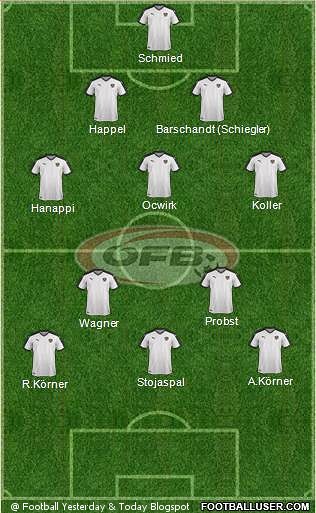
Austria, Semi-finalist and 3rd at the 1954 World Cup in Switzerland.

Austria 1954
Group Stage :
Austria v Scotland : 1-0 (Probst)
Austria v Czechoslovakia : 5-0 (Stojaspal x2, Probst x3)
(Uruguay topped the group, the four teams only played two games each)
Q/F's :
Austria v Switzerland : 7-5 (Wagner x3, A. Körner x2, Ocwirk, Probst)
S/F's :
West Germany v Austria : 6-1 (Probst)
3rd place match :
Austria v Uruguay : 3-1 (Stojaspal pen., o.g., Ocwirk)


Dienst played at the centre forward position in the very first match (against Scotland) and left winger in the very last (the third place match). Schlegler played against Scotland, numerically instead of Happel and in the semis instead of Barschandt.
Probst was the second best scorer in the tournament alongside the Swiss Hügi and the German Morlock with six goals, behind Kocsis of Hungary who found the end of nets eleven times. 
That Hungarian side were by many aspects the heirs of the Wunderteam.


Austria finsihed last of the Group A at the World Cup '58 in Sweden. Defeated 3-0 then 2-0 by Brazil and the Soviet Union, Austria drew with England for their last group stage match (2-2). Happel, Hanappi, Koller and A.Körner were still on the team and the others from '54 were not truely replaced. Schmied only played against the Soviet team.


In the early 60s (1960-61), with a new generation of players, Austria seemed to know a sort of revival (though in different fashion than the Wunderteam) but couldn't qualify to any tournament.
They have had a good sequence of wins that occured after they were eliminated on the road to the first Euro finals ever by France (quarter-finals). The French press had observed that Austria was making a sort of come-back at the highest level but in the prolongation of their Swedish summer, France won quite easily with Kopa and Fontaine on the team, almost for the last time.
Making those laudatory comments was not all about bluff or about to spice things up from the French as proven with that sequence of victories that happened right after against the likes of Scotland, the Soviet Union, Spain, Hungary, Italy in 1960; England, Hungary and the Soviet Union again in '61.
In friendlies though whilst in 1961, when the mentioned teams had for their objective to qualify for the next World Cup in Chile, Austria withrdrew from the qualifications process. In their group, they had to meet Wales and Spain.
In November '61, Austria is defeated in Yugoslavia then the year '62 would be awful and in the end, it is only some semblance of a revival that would not even be confirmed until the end of the decade and beyond. In spite of one player, a techncial one like the great Austrian players of past and annouced as a possible future great in Europe. The why we lingered on this generation. The one who was seen as a "little Kopa" by the French press at the begining of the 60s.
This young man who was the main player of the Austrian attack in those times was Hof. He was seconded by the way less technical and way more physical Nemec. Hanappi was still there. Incidentally, Hof did not play in either of the two legs played against France in '59 and '60. His international career knew a stop in the mid 60's and he ended it in 1967-68 scoring the last 6 of his 28 goals in 37 caps. 6 anecdotical goals.
One of the best talents Austria had had since some time though, and that they won't have again for a long time.

Since then we'll get some news from Austria only in the late 70's. Austria Wien was the runner-up in the Cup Winners Cup and the national team has qualified to the World Cup, held in Argentina. We're in 1978.


Austria, last of the group A in the second phase of the World Cup 1978.

Austria 1978
First Round :
Austria v Spain : 2-1 (Schachner, Krankl)
Austria v Sweden : 1-0 (Krankl pen.)
Brazil v Austria : 1-0
Second Round :
Austria v Holland : 1-5 (Obermayer)
Italy v Austria : 1-0
Austria v West Germany : 3-2 (o.g, Krankl x2)


Here, we have quite some team again.

Hickersberger is a right midfielder who could attack as well but in a different style of Kreuz who was more of a "natural striker" so to speak : more like an attacking midfielder concerning the first named, more like a winger/ striker for the second. Hickersberger defended more too, or in any case a bit  better.
Jara and Schachner were in balance during the whole competition except in the very  first match of it when they played together. Schachner was preffered to Jara in the very last game against West Germany but was subbed out at the 70th minute. For Oberacher, another young striker of 24 years. Schachner was only 21. Jara was 28).


In the Euro '80 qualifiers, Austria missed to make the finals (8-team tournament) quite for a few, finishing 1 pt behind Belgium and they were, with Yugoslavia, Poland and France one of the "best second" (before that, in the Euro Nations Cup qualifiers, they were neatly beaten and eliminated as suggested and later on, in the next Euro qualifiers, it would be the same, with even worse results but let's continue it chronologically).

Then, Austria finished second in the group D in the second phase of the World Cup 1982.
No major changes since the '78 team so this formation will not be presented. One note though : Welzl generally entered in attack in the second half, like against Algeria in the second group stage match and then in the two games of the second round.
As for that infamous game with West Germany...


Austria would reappear on the international scene only 8 years later.


1st round exit at Italia '90.
Beaten by 1-0 by Italy then Czechoslovakia, winner of the U.S by 2-1 in their last game, the team quite shuffled through the three games.
The centre-forward Polster (0 goals scored) and the young (attacking) midfielder Herzog were the stars. The forwards Ogris and Rodax were the two scorers.


1st round exit at France '98. In spite of 0 wins, Austria was far to be ridiculous though really, it was difficult : 3 goals scored in the injury time to get two draws against Cameroon and Chile and to save the honour against Italy in a 1-2 loss.

Like Herzog and the veteran Polster (34 years old), Schöttel (31) was on the 1990 team. Herzog was subbed off at the 82nd minute in the fist game agianst Cameroon then made his last two World Cup appearances coming from the bench. He's scored from the penalty-spot against Italy. Polster was the scorer against Cameroon and Vastic was against Chile.
The team had some other good names with first the keeper Konsel, the defender Feiersinger, the midfielders Cerny (who was out at the half-time of the match with Chile) and Kübauher (who couldn't play the full 90 minutes against Chile and Italy)... without forgetting the 24 years old forward Mario Haas.
Apart from the innamovible attacking duo Polster and Vastic as well as the innamovible back-three Schöttel, Pfeffer and Feiersinger, the starting players changed quite a lot in just three games thus the absence of a layout for this team.


Group stage exit at the Euro 2008 on home soil. That was the first time that Austria entered an Euro tournament.

Difficult to present a typical team over only three games during wich the team has changed quite a lot again.
The announced star of the team was the number 10 Ivanschitz, 25 years old. We'll then cite the midfielder Aufhauser, the defenders Stranzl and Prödl. Vastic came from the bench in the two first games and scored an equalizer from the penalty spot against Poland in order to win 1 point in this group after an initial loss to Croatia (1-0, Modric pen.) and before a 1-0 loss to neighbours Germany. A 22 years old left back named Christian Fuchs played this last game by the way.


Group stage exit at the Euro 2016 in France (24-team tournament).
For the first time Austria qualified to the Euro finals by topping their group which included Russia (2nd) and Sweden (3rd). This, without conceding one single deafeat.

During the finals, a draw with the eventual champion Portugal in the second game after a loss to Hungary and before another loss to Iceland sealed their fate. Result : last of the group F.
Fuchs was this time the captain, Arnautovic the successor of Ivanschitz and Alaba from Bayern was the player with a high profile.
Their only goal was scored by the young forward Schöpf and not the veteran centre-forward Janko. Prödl was still part of the squad but was awful as a defensive midfielder. The right-back Dragovic was sent-off in the first game. A catastrophe in sum.


In the UEFA 2018-2019 Nations League B, Austria has registered one loss to Bosnia (1-0, Dzeko) and one win over Northern Ireland (1-0, Arnautovic) so far.